Artificial intelligence has moved far beyond simple chatbots. In 2026, one of the biggest developments in technology is the rise of AI agents—systems designed not only to answer questions but also to plan tasks, make decisions, use digital tools, and complete actions on behalf of users.
AI agents are becoming an important part of business software, online shopping, productivity tools, software development, and everyday digital experiences. Industry research increasingly points toward agentic AI becoming a standard part of how people and businesses interact with technology.
But what exactly is an AI agent, and why is everyone talking about it?
What Is an AI Agent?
A traditional AI chatbot generally responds when you give it a prompt.
An AI agent is designed to go a step further.
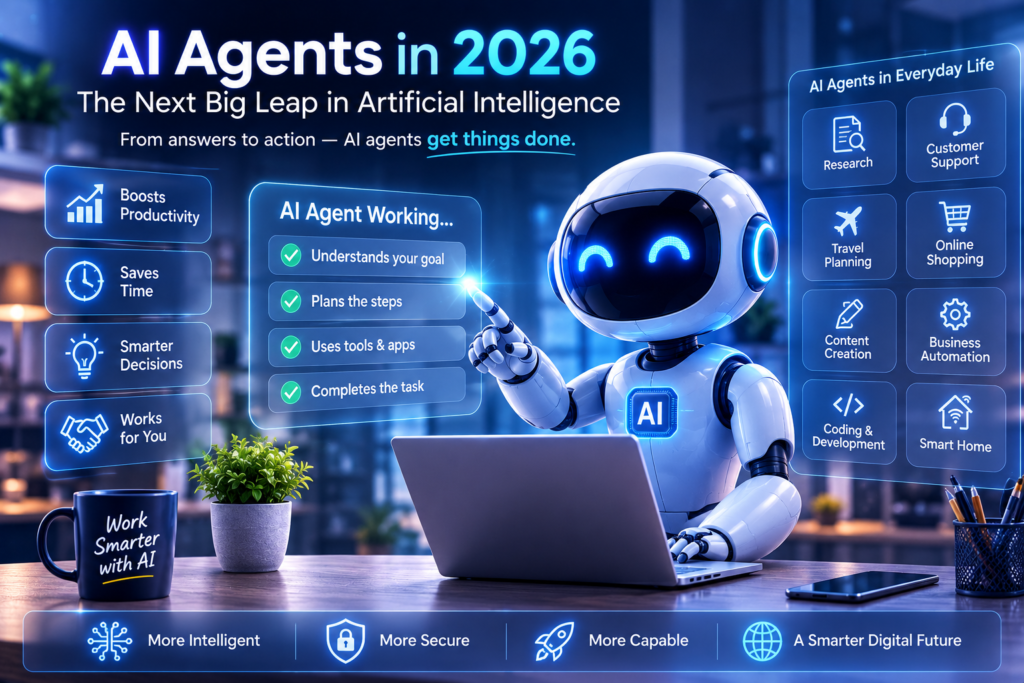
Instead of simply providing an answer, an AI agent can understand a goal, break it into smaller tasks, use available tools, and work through multiple steps to achieve an outcome.
For example, instead of asking an AI tool to explain how to plan a trip, you could potentially give an agent a goal such as finding suitable flights, comparing options, organizing an itinerary, and preparing the information for you.
The key difference is action.
How Do AI Agents Work?
AI agents typically combine several technologies, including large language models, external tools, databases, APIs, and automated workflows.
A simplified process looks like this:
Understand → Plan → Act → Check → Adjust
The agent first understands what the user wants. It then determines the steps required, performs those actions using available tools, checks the results, and adjusts its approach when necessary.
This makes agentic AI particularly interesting for tasks that involve multiple steps rather than a single question.
Why AI Agents Are Becoming Important
One of the biggest reasons businesses are interested in AI agents is productivity.
Companies are increasingly looking beyond AI experiments and trying to integrate AI into real workflows. Recent technology research highlights the shift from isolated AI pilots toward broader implementation, with organizations focusing on measurable business value, data infrastructure, security, and workforce readiness.
AI agents can potentially help with tasks such as:
- Research and information gathering
- Customer support
- Scheduling
- Data analysis
- Software development
- Marketing workflows
- Document processing
- Business operations
- Online shopping
Instead of replacing every employee, the more realistic near-term use case is often helping people complete more work in less time.
AI Agents vs. Chatbots
The difference can be easy to understand.
Traditional chatbot:
You ask a question → It provides an answer.
AI agent:
You provide a goal → It plans the work → Uses tools → Completes multiple steps → Reports the result.
This doesn’t mean every AI agent can operate independently. Their capabilities depend heavily on the tools, permissions, data, and safeguards provided by their developers.
AI Agents Are Entering the Real World
Another major development is that AI is moving beyond purely digital environments.
Research into emerging technologies in 2026 highlights the growing importance of physical AI, robotics, autonomous systems, and agentic software. In other words, AI is increasingly being connected to the physical world rather than remaining limited to websites and applications.
This could eventually lead to smarter robots, vehicles, household devices, and other systems that can interpret their surroundings and respond to changing situations.
AI-Powered Shopping Could Change Online Commerce
Online shopping is another area where AI agents could have a major impact.
Instead of visiting multiple websites, searching for products, comparing prices, reading reviews, and completing checkout manually, consumers may increasingly rely on AI assistants to help manage parts of that process.
Recent industry reporting shows that AI shopping assistants are already changing how consumers discover products, while retailers are thinking about how to maintain direct relationships with customers as AI becomes another layer between shoppers and merchants.
This could make online shopping more convenient—but it also raises important questions about privacy, recommendations, pricing, and trust.
The Risks of AI Agents
AI agents offer significant potential, but they also introduce new challenges.
The more authority an AI system has, the more important security becomes. An agent that can access emails, files, accounts, payment systems, or business applications needs appropriate permissions and safeguards.
There are also concerns around inaccurate information, unintended actions, privacy, cybersecurity, and accountability.
That’s why the future of AI isn’t just about making agents more capable. It is also about making them secure, transparent, and reliable.
What Does the Future Look Like?
AI agents are still evolving, but the direction is clear: AI is moving from simply generating information toward helping people complete tasks and achieve goals.
Over the next few years, we could see AI assistants becoming more deeply integrated into smartphones, computers, business applications, shopping platforms, and smart devices.
The biggest change may not be a single revolutionary product. Instead, AI could gradually become an invisible layer working behind the technology people already use every day.
Final Thoughts
AI agents represent one of the most interesting developments in modern technology.
The transition from “AI that answers” to “AI that acts” could change how people work, shop, communicate, and use digital services.
But the technology is still developing. The winners will likely be the companies that can combine powerful AI with reliable data, strong security, useful workflows, and human oversight.
For consumers, the best approach is simple: stay curious, understand how these tools work, and pay attention to how AI is becoming part of the technology you already use.