Remember when AI was mainly something you used to ask questions, generate an image, or write an email?
That era is changing.
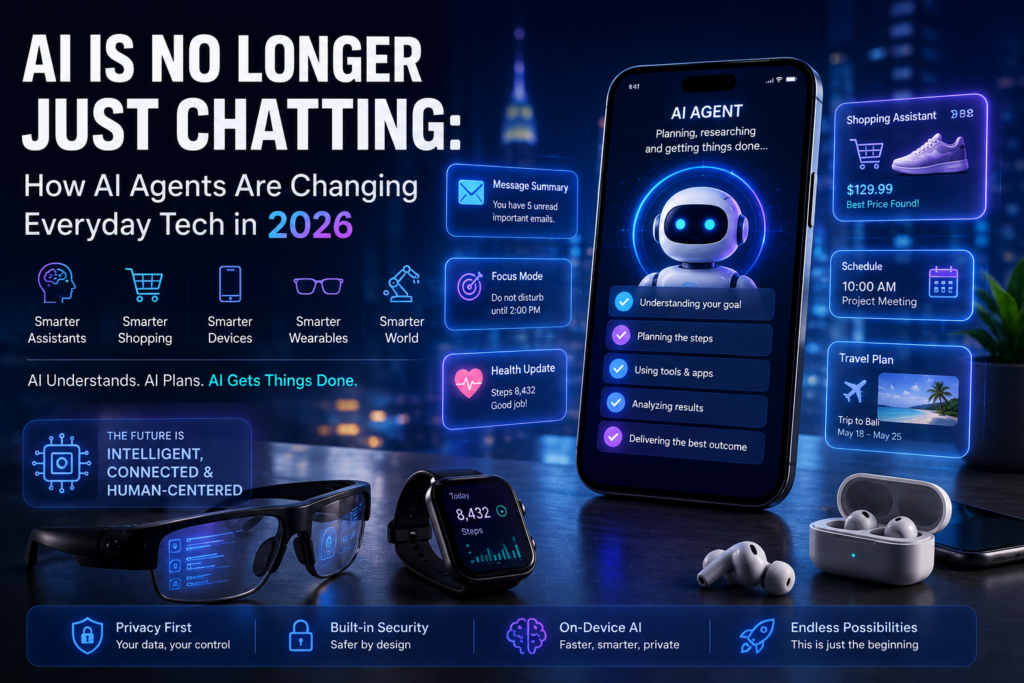
In 2026, the next generation of AI is becoming much more action-oriented. AI agents are being designed to understand goals, plan multiple steps, use digital tools, and actually get things done.
That shift could change how we use smartphones, computers, apps, shopping platforms, and even smart devices.
What Exactly Is an AI Agent?
A normal chatbot waits for you to ask something and then gives you an answer.
An AI agent is designed to work toward a goal.
For example, instead of asking:
“What are the best laptops for college?”
You could eventually tell an AI agent:
“Find me a laptop under my budget, compare the best options, check reviews, and prepare the top three choices.”
The difference is subtle but powerful.
The AI isn’t simply giving you information. It is handling a series of tasks on your behalf.
Multiagent systems are now among the technology trends being highlighted for 2026, reflecting the industry’s move toward AI systems that can coordinate more complex workflows.
Your Phone Could Become More Like a Personal Assistant
Smartphones aren’t disappearing anytime soon. Instead, they’re becoming more intelligent.
Modern devices are increasingly being designed as AI hubs that connect smartphones, PCs, wearables, smart homes, and other devices. On-device AI can also process certain tasks locally, which can reduce dependence on cloud processing and improve privacy and response times.
Imagine your phone understanding your daily routine.
It could potentially remind you about an appointment, summarize important messages, help organize your calendar, identify suspicious calls, and provide useful information without requiring you to jump between several apps.
The smartphone may not need to become more complicated.
It may actually become simpler to use because AI handles more of the complexity behind the scenes.
AI Agents Could Change Online Shopping
Shopping is another area where AI agents could make a noticeable difference.
Instead of opening ten tabs to compare products, consumers could increasingly use AI assistants to discover products, compare specifications, analyze reviews, and narrow down choices.
The experience could shift from:
Search → Browse → Compare → Decide
to:
Tell AI what you want → AI researches → You choose
That’s a major change in how people interact with the internet.
It also creates a new challenge for brands and retailers: earning visibility when an AI may be helping customers decide what to buy.
AI Is Moving Into Wearables
The next generation of technology isn’t limited to phones and laptops.
AI-powered wearables—including smart glasses, smart bands, earbuds, and other compact devices—are becoming an important area of innovation. Research into emerging technology points to increasingly proactive, voice-based and context-aware wearable experiences.
This could eventually mean less time staring at screens.
Instead of opening an app, you might simply speak to your glasses or earbuds and receive the information you need.
For younger users who already live across multiple digital platforms, this kind of hands-free technology could feel completely natural.
But There’s a Catch: AI Needs Guardrails
More powerful AI also means more responsibility.
An AI that can only answer questions has limited access to your digital life.
An AI agent that can access files, applications, accounts, messages, or other systems has much more power—and therefore needs stronger security.
Cybersecurity researchers are already highlighting new risks associated with increasingly autonomous AI systems. As agents become more capable, protecting their permissions, data, and connections becomes just as important as improving their intelligence.
The future of AI won’t simply be about asking:
“How smart is this AI?”
We’ll also need to ask:
“What is this AI allowed to do?”
Physical AI Could Be the Next Big Step
Here’s where things get even more interesting.
AI is beginning to move beyond screens.
Robotics, autonomous machines, drones, and other forms of physical AI are being developed to sense their environment, make decisions, and take action in the real world. Physical AI is one of the major technology directions identified for 2026.
That could eventually mean smarter robots in warehouses, factories, homes, hospitals, and other environments.
We’re moving toward a world where AI doesn’t just generate information.
It can potentially interact with the world around us.
What This Means for the Next Generation
For younger users, AI may not feel like a separate technology for very long.
It could simply become part of everyday life.
Students may use AI to organize projects. Creators may use it to develop ideas. Developers may work alongside AI coding agents. Shoppers may use AI to compare products. Professionals may rely on AI assistants to handle repetitive tasks.
The biggest change may be that people won’t always think about “using AI.”
They’ll simply use technology—and AI will be working underneath it.
The Real Question: What Comes Next?
The technology industry is moving from AI that responds toward AI that understands, plans, and acts.
That doesn’t mean humans are becoming irrelevant. In fact, human judgment may become even more important as AI systems gain more capabilities.
The people who benefit most from this next wave won’t necessarily be those who know the most technical jargon.
They’ll be the ones who understand what AI can do, where it can help, and when human control still matters.
Final Take
The next generation of technology isn’t just about faster phones, better cameras, or bigger screens.
It’s about technology becoming more intelligent, personalized, connected, and proactive.
AI agents, smart devices, wearables, and physical AI are all pointing toward the same direction:
Technology that doesn’t just wait for you—it works with you.
And honestly, we’re probably only seeing the beginning.