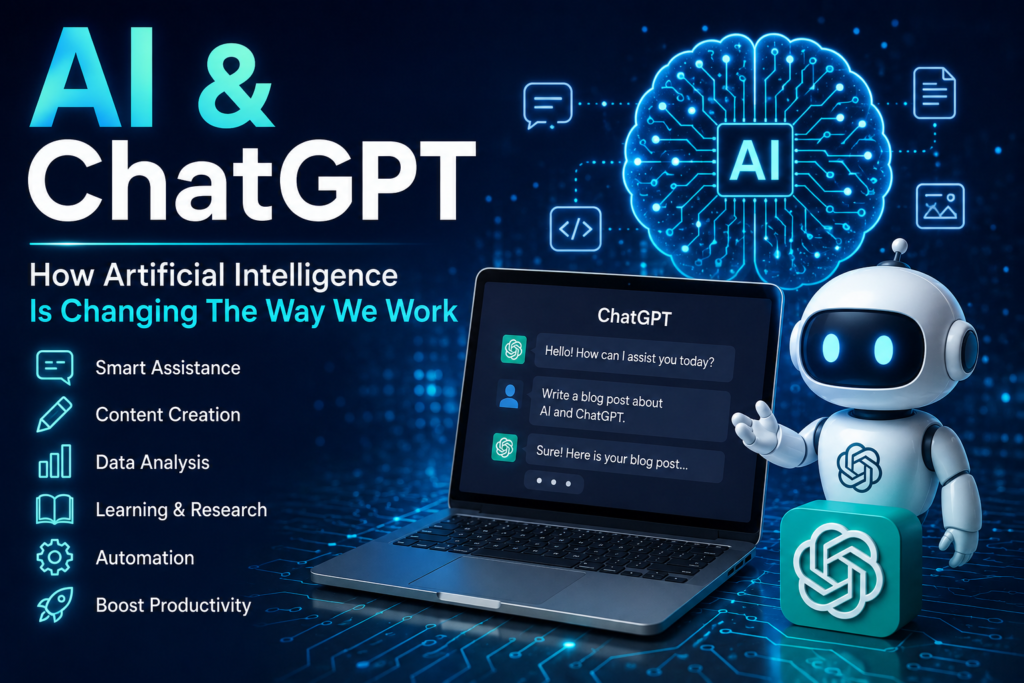
Artificial intelligence has moved from being a futuristic idea to something millions of people use every day. From writing emails and creating images to analyzing information and learning new skills, AI tools are quickly becoming part of everyday life.
One of the biggest names in this space is ChatGPT. What started as an AI chatbot has evolved into a useful digital assistant for students, professionals, creators, developers, and businesses.
But what exactly is AI, and how can ChatGPT actually help you?
What Is Artificial Intelligence?
Artificial Intelligence (AI) refers to computer systems designed to perform tasks that normally require human intelligence. These tasks can include understanding language, recognizing patterns, solving problems, generating content, and making predictions.
AI is already being used in areas such as healthcare, finance, education, marketing, customer service, cybersecurity, and software development.
The technology is improving quickly, but its biggest advantage for everyday users is simple: it can help people get more done in less time.
What Is ChatGPT?
ChatGPT is an AI-powered conversational tool that can understand natural-language instructions and generate responses based on the context of a conversation.
Instead of searching through multiple websites for every question, users can describe what they need and ask ChatGPT to help.
For example, you can use ChatGPT to:
- Brainstorm content ideas
- Summarize long documents
- Write or improve emails
- Explain complicated topics
- Create outlines and drafts
- Help with coding
- Analyze information
- Translate and rewrite text
- Generate marketing ideas
- Learn new concepts
The quality of the result often depends on how clearly you explain your goal.
How ChatGPT Can Improve Productivity
One of the biggest benefits of AI is productivity.
Imagine spending 30 minutes creating a first draft of an email. With ChatGPT, you can provide the key points and ask it to create a professional draft that you can review and personalize.
The same idea works for research, brainstorming, documentation, meeting notes, content planning, and repetitive writing tasks.
AI does not necessarily replace the work. Instead, it can reduce the amount of time spent on repetitive tasks and give people more time to focus on decisions and creative thinking.
AI for Content Creation
Content creators and marketers are among the groups that can benefit significantly from AI.
ChatGPT can help generate blog ideas, headlines, social media concepts, content outlines, FAQs, product descriptions, and SEO ideas.
However, simply publishing AI-generated content without reviewing it is not a good strategy.
Human experience still matters. Adding original insights, examples, opinions, data, and useful information can make content more valuable and authentic.
The best approach is to use AI as a content assistant, rather than treating it as a complete replacement for human creativity.
ChatGPT for Learning
AI can also become a personalized learning assistant.
Instead of simply asking for an answer, you can ask ChatGPT to explain a topic at a beginner level, provide examples, create practice questions, or explain why an answer is correct.
For example:
“Explain cloud computing as if I am completely new to technology.”
You can then continue asking questions until the concept becomes clear.
This makes AI particularly useful for people who want to learn at their own pace.
AI and the Future of Jobs
One of the biggest questions surrounding artificial intelligence is its impact on employment.
Some tasks will almost certainly become automated. At the same time, new roles and opportunities are emerging around AI, data, automation, cybersecurity, software development, and digital transformation.
Rather than focusing only on whether AI will replace jobs, it may be more useful to consider how AI will change the way people perform those jobs.
Professionals who understand how to work effectively with AI may have an advantage over those who completely ignore the technology.
The Importance of AI Literacy
You do not need to become an AI engineer to benefit from artificial intelligence.
AI literacy means understanding what AI can do, where it can help, where it can make mistakes, and how to use it responsibly.
This includes learning how to write clear prompts, verify important information, protect sensitive data, and critically evaluate AI-generated answers.
These skills are becoming increasingly useful across almost every industry.
What Comes Next for AI?
AI technology is still developing rapidly. Future tools are likely to become better at understanding context, working across different types of information, automating workflows, and assisting with increasingly complex tasks.
The biggest shift may not be a single revolutionary AI tool. Instead, AI could gradually become part of the software people already use every day.
For users, the smartest approach is to start experimenting, learn the basics, and understand how AI can complement their existing skills.
Final Thoughts
AI and ChatGPT are changing how people search for information, create content, solve problems, and work online.
The technology is powerful, but it is not perfect. AI-generated information should still be reviewed, especially when accuracy is important.
The real advantage comes from combining AI with human judgment, creativity, experience, and critical thinking.
You do not need to become an AI expert overnight. Start with one task, learn how AI can make it easier, and gradually expand from there.