
Technology is changing the way we work, create content, analyze data, and grow businesses online.
A few years ago, digital marketers could get by with a keyword research tool, analytics software, and a spreadsheet. Today, AI-powered platforms can analyze competitors, identify content opportunities, monitor search visibility, optimize articles, and even automate repetitive marketing tasks.
If you want to stay competitive in 2026, knowing which tools are actually useful can make a big difference.
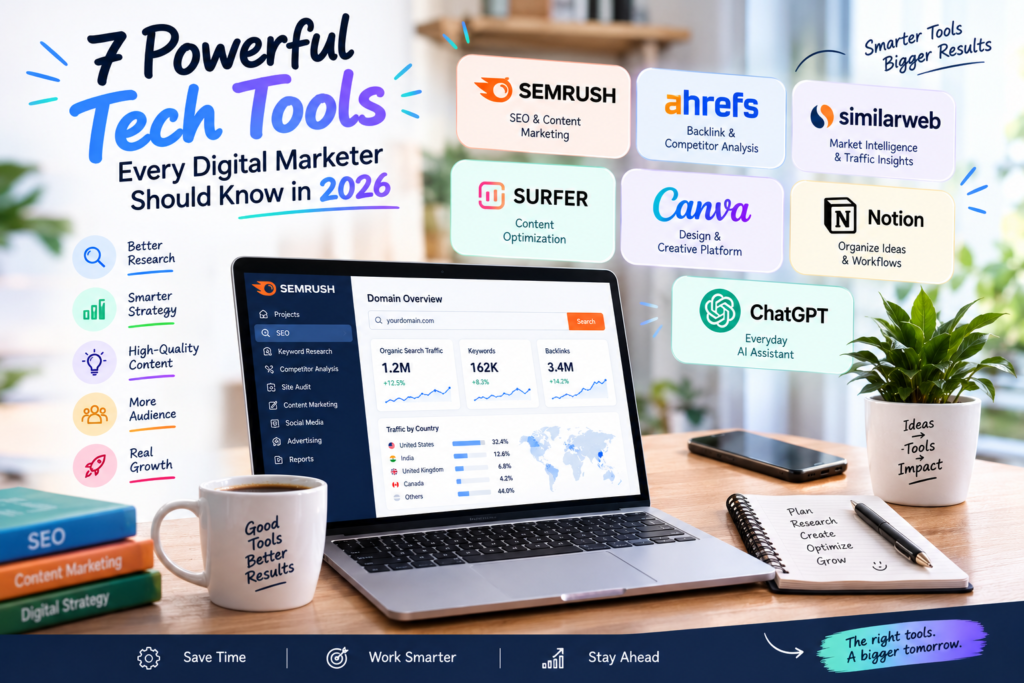
Here are seven technology tools worth knowing about right now.
1. Semrush: An All-in-One Marketing Platform
Semrush has long been one of the best-known platforms for SEO and digital marketing, but its focus is increasingly expanding toward AI search.
Its tools can help users research keywords, analyze competitors, audit websites, track rankings, and optimize content.
One of the biggest developments is its AI Visibility Toolkit, which helps businesses understand how their brands appear in AI-generated answers across platforms such as ChatGPT, Gemini, and Perplexity. Semrush has also expanded its AI visibility database to 32 countries, with more than 261 million LLM prompts in its database.
For businesses trying to understand both traditional Google search and AI search, Semrush is becoming increasingly useful.
2. Ahrefs: More Than Just Backlink Analysis
Ahrefs is another major name in the SEO industry.
The platform is widely known for backlink research, competitor analysis, keyword research, and website auditing. But Ahrefs is also adding more AI-powered capabilities.
Its current AI features include AI Content Helper, AI Search Intent, AI Suggestions, AI translations, and AI-powered visibility features.
Ahrefs has also been pushing heavily into AI agents for SEO. Its newer agent-focused approach is designed to automate multi-step marketing tasks rather than simply generate answers.
For SEO professionals, this represents an important shift: tools are beginning to move from showing data to helping users act on that data.
3. Similarweb: Understand What’s Happening Across the Web
Similarweb is particularly useful for understanding websites, markets, competitors, and digital audiences.
Instead of looking only at your own website, competitive intelligence platforms can help answer questions such as:
- Where are competitors getting traffic?
- Which websites are growing?
- What channels appear to be driving audience growth?
- What trends are emerging in a particular market?
Similarweb has also been developing AI-focused products, including AI agents and AI visibility tools. Its 2026 updates include tools designed to understand how brands appear across AI search and answer engines.
For marketers and business owners, this type of intelligence can be useful when deciding where to invest time and money.
4. Surfer: AI-Powered Content Optimization
Creating content is easy.
Creating content that is useful, competitive, and optimized for search is much harder.
Surfer focuses heavily on content optimization. It helps writers analyze competing pages and improve content based on search-related signals.
The broader trend is particularly interesting in 2026: content tools are increasingly being designed for both traditional search and AI-generated search results.
Instead of simply asking, “Can I rank on Google?”, content teams increasingly need to think about whether their content can also become a useful source for AI-generated answers.
5. Canva: From Design Tool to AI Creative Platform
Canva has become much more than a simple graphic design platform.
For content creators and marketers, it can be used to create social media graphics, presentations, videos, advertisements, thumbnails, infographics, and other visual assets.
AI features are also making the creative process faster by helping users generate designs, edit images, create content, and adapt visuals for different formats.
For smaller teams, having design and AI capabilities in one platform can reduce the need to switch between multiple tools.
6. Notion: Organize Ideas, Projects, and AI Workflows
Notion has become a popular workspace for teams that want to keep notes, documents, projects, databases, and workflows in one place.
Its AI capabilities make it more useful for modern teams by helping users summarize information, find answers within workspace content, generate drafts, and organize information.
For content teams, for example, a single workspace can contain content calendars, article ideas, research, briefs, publishing schedules, and project documentation.
The value isn’t just AI generation. It’s having information organized in a place where people can actually use it.
7. ChatGPT: The Everyday AI Tool
AI tools are becoming increasingly specialized, but general-purpose AI assistants remain extremely useful.
ChatGPT can help with brainstorming, research, writing, coding, data analysis, summarization, planning, and many other tasks.
The biggest change isn’t necessarily that AI can write text.
It’s that AI is increasingly becoming a general-purpose productivity layer.
A marketer can use it to brainstorm campaign ideas. A developer can use it to understand code. A student can use it to break down complicated topics. A business owner can use it to organize ideas or analyze information.
The important skill is learning how to give AI useful context and verify the results rather than blindly accepting everything it produces.
The Biggest Technology Trend: Tools Are Becoming More Intelligent
Looking at these platforms, one trend stands out.
Technology tools are moving from passive software to active assistants.
Traditional software might show you a list of keywords.
Modern software can analyze those keywords, identify opportunities, recommend actions, and sometimes automate the next step.
This is particularly visible in SEO and digital marketing. Ahrefs, Semrush, Similarweb, and other platforms are increasingly adding AI capabilities that connect research, analysis, content, and execution.
That doesn’t mean humans are becoming unnecessary.
Instead, the role of the user is changing.
Rather than spending hours collecting information manually, people can spend more time deciding what to do with the information.
How to Choose the Right Tech Tool
You don’t need every tool on this list.
The best approach is to start with the problem you’re trying to solve.
If you need SEO and competitor research, Semrush or Ahrefs may be a strong starting point.
If you need digital market intelligence, Similarweb may be more useful.
If your main focus is content optimization, a platform such as Surfer could fit better.
For visual content, Canva is an obvious option.
And for general productivity and AI assistance, ChatGPT can cover a much broader range of tasks.
The goal isn’t to collect subscriptions.
It’s to build a technology stack that saves time and produces better results.
Final Thoughts
The latest generation of technology tools is changing the way people work online.
Platforms such as Semrush, Ahrefs, Similarweb, Surfer, Canva, Notion, and ChatGPT are increasingly combining traditional software with artificial intelligence.
The biggest opportunity isn’t simply using AI because it’s popular.
It’s finding the tools that solve real problems, learning how to use them effectively, and combining automation with human judgment.
As AI search, AI agents, and intelligent workflows continue to develop, the people who learn to work with these tools—not just use them occasionally—could have a significant advantage.
Technology isn’t replacing the way we work. It’s changing what we can accomplish with the same amount of time.