
Artificial intelligence has already changed the way we search, write, create content, and get work done. But a new wave of AI technology is getting even more attention: AI agents.
Unlike traditional AI tools that mainly respond to instructions, AI agents are designed to take action. They can break a task into steps, use different tools, make decisions, and work toward a specific goal with less human involvement.
That sounds futuristic, but AI agents are quickly becoming part of real-world business and everyday workflows.
So, what exactly are AI agents, and why is everyone suddenly talking about them?
What Are AI Agents?
An AI agent is a software system that can understand a goal, plan how to achieve it, and perform actions using available tools.
A traditional chatbot might answer:
“Here are five ideas for your next blog.”
An AI agent could potentially take the process further by researching a topic, organising information, creating an outline, drafting content, checking it against specific requirements, and preparing it for review.
The key difference is action.
AI agents are designed not just to provide information but to help complete tasks.
How Are AI Agents Different From Chatbots?
Chatbots and AI assistants are useful for conversations and individual tasks. You ask a question, provide an instruction, and receive a response.
AI agents can operate more like digital workers.
For example, imagine telling an AI agent:
“Find suitable leads for our business and organise them into a spreadsheet.”
Instead of simply explaining how to find leads, an agent could potentially:
- Search approved sources
- Collect relevant information
- Filter results based on specific criteria
- Organise the information
- Create a report
- Ask for approval before taking the next step
The exact capabilities depend on the system, connected tools, and permissions.
Why Are AI Agents Becoming So Popular?
One major reason is that AI has become much better at understanding natural language.
You no longer need to know complicated software commands to explain what you want. You can describe a goal in everyday language and let the AI determine how to approach it.
At the same time, modern AI systems can connect with software, databases, browsers, APIs, and other digital tools.
This combination creates something much more powerful than a simple chatbot.
AI Agents Can Automate Repetitive Work
Think about the tasks you perform repeatedly every week.
Checking information. Organising files. Updating spreadsheets. Summarising reports. Responding to routine questions. Preparing documents. Monitoring certain activities.
Many of these tasks don’t require constant human creativity. They require time.
AI agents could potentially handle parts of these workflows automatically, allowing people to focus on decisions and work that requires human judgment.
AI Agents in Business
Businesses are particularly interested in AI agents because they can potentially automate entire workflows rather than individual tasks.
For example, a company could use an AI agent to help with:
- Customer support
- Lead qualification
- Research
- Data analysis
- Marketing workflows
- Report generation
- Software development
- Internal knowledge searches
- Scheduling and administration
- Document processing
The goal isn’t necessarily to replace an entire team.
In many cases, the more practical goal is to reduce repetitive work and help employees get more done.
AI Agents Could Change Customer Service
Customer service is another area where AI agents could make a major difference.
A basic chatbot might answer a customer’s question using a knowledge base.
An AI agent could potentially understand the problem, check relevant account information, find an appropriate solution, update a system, and escalate the issue to a human when necessary.
That creates a more active form of customer support.
However, businesses still need safeguards to make sure agents don’t make inappropriate decisions or access information they shouldn’t.
AI Agents for Personal Productivity
You don’t have to run a large company to benefit from AI agents.
Personal AI agents could eventually help people manage everyday digital tasks.
Imagine an assistant that helps organise your calendar, summarise important emails, prepare a daily task list, compare information, or organise travel plans based on your preferences.
The real value comes from connecting multiple tasks together.
Instead of using five different apps manually, an AI agent could potentially coordinate parts of the workflow for you.
The Rise of the “AI Employee”
You’ve probably heard the phrase AI employee or digital worker appearing more often.
The idea is that businesses could give AI systems specific responsibilities, tools, and rules, allowing them to handle defined workflows.
For example, an AI system might be responsible for preparing a daily sales report. Another could assist with customer enquiries, while another helps developers review code.
These systems wouldn’t necessarily work completely independently. Humans could still provide instructions, approvals, oversight, and final decisions.
Think of them less as replacements for people and more as digital team members that can handle specific tasks.
Are AI Agents Reliable?
This is where things get interesting.
AI agents are powerful, but they aren’t perfect.
An agent can misunderstand an instruction, use incorrect information, make a poor decision, or perform an action differently from what you expected.
That’s why human oversight remains important, particularly when an AI agent has access to sensitive information, financial systems, customer accounts, or important business operations.
The more power an AI agent has, the more carefully its permissions and actions need to be controlled.
Privacy and Security Concerns
AI agents also raise important cybersecurity and privacy questions.
If an agent can access your email, documents, calendar, customer database, or other services, you need to know exactly what it can access and what actions it is allowed to perform.
Giving an AI agent unlimited access isn’t a good security strategy.
Businesses should use appropriate permissions, monitor activity, protect sensitive information, and require human approval for high-risk actions.
Will AI Agents Replace Jobs?
This is probably the biggest question surrounding the technology.
AI agents will likely automate some tasks currently performed by humans. But jobs are made up of many different tasks, and not all of them can be automated equally well.
Instead of simply asking whether AI agents will replace jobs, it may be more useful to ask:
Which parts of a job can AI handle, and which parts still require human skills?
Communication, creativity, leadership, judgment, relationship building, strategy, and accountability will remain important.
People who learn how to work effectively with AI may have an advantage as these systems become more capable.
How to Prepare for the AI Agent Era
You don’t need to become an AI developer to prepare.
Start by understanding how AI tools work and identify repetitive tasks in your own routine.
Learn how to:
- Write clear instructions
- Evaluate AI-generated information
- Automate simple workflows
- Protect sensitive information
- Check AI outputs
- Use AI responsibly
- Identify tasks that genuinely benefit from automation
The most valuable skill may not be knowing one particular AI tool. It may be knowing how to work with AI effectively.
The Future of AI Agents
AI agents are still evolving, and their capabilities will continue to change.
The biggest shift could be moving from AI that simply answers questions to AI that actively helps complete goals.
Instead of saying:
“Tell me how to do this.”
People may increasingly say:
“Help me get this done.”
That’s a significant change in how we interact with technology.
Final Thoughts
The sudden interest in AI agents isn’t just another technology trend. It reflects a broader shift in artificial intelligence—from generating answers to performing tasks.
AI agents could make software more useful, automate repetitive workflows, and give individuals and businesses powerful digital assistants.
But greater capability also means greater responsibility. Security, privacy, accuracy, and human oversight will become increasingly important.
The technology is still developing, but one thing is becoming clear: the future of AI may not be about simply talking to machines. It may be about working alongside them.
SEO Keywords
Primary keyword: AI agents
Secondary keywords: what are AI agents, AI agent technology, artificial intelligence agents, AI automation, AI agents for business, AI productivity, AI digital workers, AI assistants, future of AI, AI automation tools, how AI agents work
Emergent Affiliate Program: Turn Your Audience Into App Builders
Building a website or app used to require coding knowledge, expensive development teams, and weeks or even months of work. Today, AI is changing that.
Platforms like Emergent are making it possible to describe an idea in plain language and turn it into a working web or mobile application. That makes Emergent an interesting tool not only for founders and creators, but also for affiliate marketers looking for a technology product with real use cases.
If you have a website, blog, social media audience, newsletter, or online community interested in AI, technology, startups, or productivity, the Emergent Affiliate Program gives you an opportunity to recommend the platform while earning commissions from qualified referrals.
What Is Emergent?
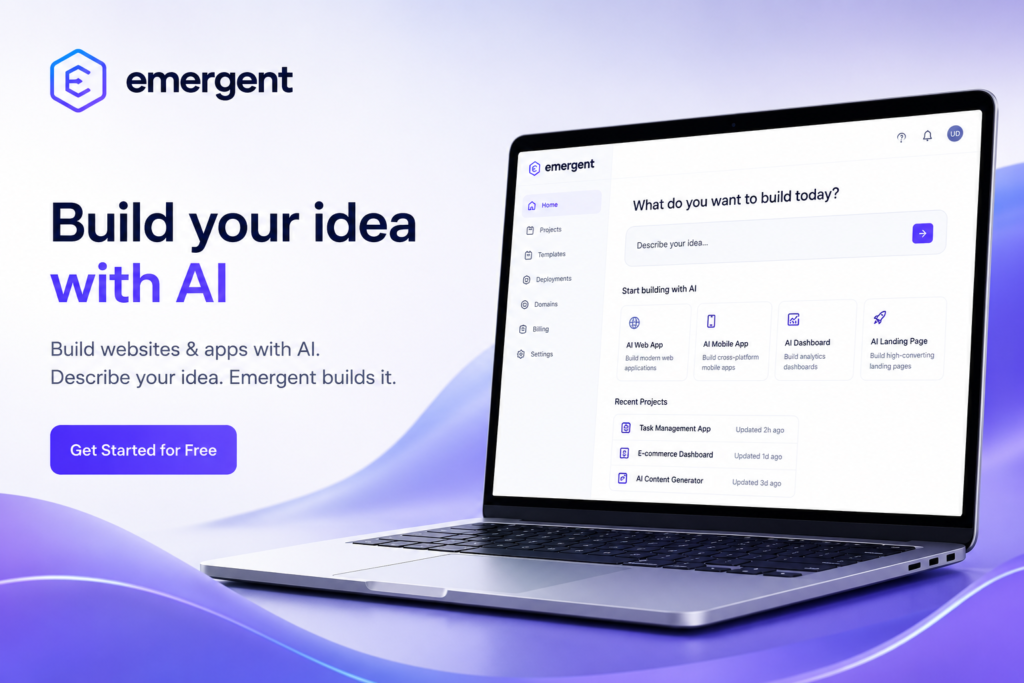
Emergent is an AI-powered application development platform built around what it calls agentic vibe coding.
Instead of starting with programming languages, frameworks, and complicated development environments, users can describe what they want to build using natural language.
Emergent’s AI then helps build, refine, and deploy the application.
According to Emergent, users can build web and mobile apps, dashboards, e-commerce projects, internal business tools, SaaS products, and other applications through conversation with AI.
This makes the platform particularly interesting for people who have ideas but don’t necessarily have a technical background.
Why Is Emergent Interesting for Affiliate Marketers?
Affiliate marketing works best when you’re promoting something that solves a genuine problem.
Emergent has several potential audiences:
- Entrepreneurs with app ideas
- Startup founders
- Small business owners
- Students
- Creators
- Marketers
- Freelancers
- Developers
- Non-technical professionals
- Side-project builders
Instead of simply promoting an AI product because it is trending, affiliates can create useful content around what people actually want to accomplish.
For example:
“How to Build an App Without Coding”
“Best AI App Builders for Beginners”
“How to Turn Your Business Idea Into an App”
“AI Tools Every Startup Founder Should Know”
These topics naturally introduce readers to the type of problem Emergent is designed to solve.
How the Emergent Affiliate Program Works
Joining the program is straightforward.
You receive a unique affiliate tracking link that you can share with your audience. When someone clicks your link, signs up, and becomes a qualifying paying customer, you can earn a commission.
Emergent currently advertises a 20% commission on referred customers for their first six months. Its affiliate guide also states that revenue share can increase to 30% based on performance milestones agreed with the Emergent team.
Emergent also states that there is no overall limit on affiliate earnings, subject to its program terms and qualifying referral requirements.
What Makes the Commission Model Interesting?
The six-month commission period is an important part of the program.
Instead of earning only from the initial purchase, affiliates can receive commissions on qualifying subscription revenue during the customer’s first six months.
Emergent’s affiliate page currently lists a 20% commission rate and six-month duration.
For affiliates, this can make promoting a subscription-based technology product particularly attractive because successful referrals can generate recurring commissions rather than relying only on one-time transactions.
What Can You Build With Emergent?
One of the strongest selling points is the range of projects users can explore.
Depending on the project, users can create things such as:
Business Tools
Small businesses can build internal dashboards, workflow tools, calculators, customer-facing applications, and other digital products.
Websites
Creators can build blogs, landing pages, portfolios, content websites, and other web experiences.
Mobile Apps
Emergent supports mobile application development, allowing users to create experiences designed for smartphones.
AI-Powered Apps
Users can also create applications that incorporate AI capabilities, making the platform interesting for entrepreneurs experimenting with AI-powered products.
Affiliate Websites
Emergent even provides an affiliate website builder designed to help users create comparison pages, content hubs, affiliate links, and monetization workflows.
Who Should Join the Emergent Affiliate Program?
The program can be particularly relevant if your audience is interested in technology or building online businesses.
Tech Bloggers
If you publish articles about AI, software, coding, SaaS, or startups, Emergent can fit naturally into tutorials and product comparisons.
Content Creators
You can demonstrate how an idea goes from a simple prompt to a working application and share the process with your audience.
Affiliate Websites
AI and software comparison websites can feature Emergent alongside other app-building and productivity platforms.
Newsletter Publishers
Technology newsletters can introduce Emergent to readers interested in new AI tools and online business opportunities.
Startup Communities
Founders and entrepreneurs can use AI development tools to experiment with ideas without immediately hiring a development team.
How to Promote Emergent Effectively
Successful affiliate marketing isn’t about placing a link everywhere.
The better strategy is to create content that helps people make a decision.
For example, instead of writing:
“Sign up for Emergent.”
You could create:
“I Tried Building a Business App With AI—Here’s What Happened.”
Then explain the process, show examples, discuss what worked, and provide your affiliate link for readers who want to try the platform.
Emergent’s own affiliate guide recommends strategies including SEO content, comparison pages, newsletters, LinkedIn content, directories, communities, and approved paid promotion approaches.
SEO Content Ideas for Emergent Affiliates
If you’re using a blog to promote the program, here are some content ideas:
- How to Build an App Without Coding
- Best AI App Builders for Beginners
- How AI Is Changing Software Development
- Can AI Really Build a Working App?
- Best No-Code and AI Tools for Entrepreneurs
- How to Turn an Idea Into an App With AI
- AI Tools Every Startup Founder Should Try
- How to Build a Website Using AI
- Best AI Tools for Small Businesses
- Emergent Review: Can AI Build Your Next App?
The key is to provide genuine information instead of producing content that feels like a sales pitch.
Why Human-Led Content Matters
AI-generated content is everywhere, which makes generic affiliate articles easy to ignore.
If you’re promoting Emergent, make your content more useful by adding:
- Real examples
- Screenshots or demonstrations
- Personal observations
- Comparisons
- Pros and cons
- Practical tutorials
- Specific use cases
- Honest limitations
Readers are more likely to trust an affiliate recommendation when they understand why the product is useful.
Important Affiliate Rules
Before promoting Emergent, affiliates should review the current program terms.
Emergent states that prohibited activities include things such as brand-keyword bidding on Google Ads, fraudulent referrals, fake accounts, self-referrals, and misleading or unethical promotion.
The program also states that affiliate promotion should comply with applicable laws and advertising standards.
Always use your own tracked affiliate link and clearly disclose affiliate relationships where required.
Is the Emergent Affiliate Program Worth Considering?
If your audience is already interested in AI, app development, entrepreneurship, SaaS, or online business, Emergent can be a natural product to introduce.
The combination of an AI-powered product, a growing interest in AI development, and a six-month commission structure makes the program worth considering for publishers with relevant audiences.
However, the best affiliate strategy is not simply to promote the highest commission.
Promote products that genuinely make sense for your audience.
When your readers find a product useful, affiliate revenue becomes a natural result of providing value rather than the entire purpose of the content.
Final Thoughts
AI is changing who can build software.
You no longer necessarily need years of programming experience to experiment with an app idea. Platforms like Emergent are making software creation more accessible by allowing users to communicate their ideas in natural language and use AI to help turn those ideas into working products.
For affiliate marketers, that creates an interesting opportunity.
If your audience wants to build apps, launch businesses, experiment with AI, or create digital products, the Emergent Affiliate Program can give you a way to introduce them to the platform while earning from qualifying referrals.
The best approach is simple: create useful content, demonstrate what the platform can do, be transparent with your audience, and let the product speak for itself.
SEO Keywords
Primary keyword: Emergent Affiliate Program
Secondary keywords: Emergent affiliate, Emergent AI affiliate program, AI affiliate programs, best AI affiliate programs, affiliate programs for tech websites, AI app builder affiliate program, AI tools affiliate marketing, Emergent AI, affiliate marketing AI tools, AI software affiliate program
Suggested SEO title: Emergent Affiliate Program: Earn With AI App Referrals
Suggested meta description: Learn how the Emergent Affiliate Program works, who can join, commission details, promotion strategies, and why Emergent is an interesting AI tool for affiliates.
Build Your Next App With AI: Why Emergent Is Changing How People Create Software
Have you ever had an app idea but stopped because you didn’t know how to code?
Maybe you wanted to build a business website, launch a mobile app, create a useful tool, or turn a simple idea into a real product. Traditionally, that meant learning programming, hiring developers, or spending weeks figuring out complicated software.
AI is changing that.
Tools like Emergent are making app development more accessible by allowing people to describe what they want in everyday language and use AI to help turn that idea into a working application.
Whether you’re a student, entrepreneur, creator, freelancer, or simply someone with a great idea, you can now experiment with software development without starting as an experienced programmer.
What Is Emergent?
Emergent is an AI-powered platform designed to help users build applications using natural-language instructions.
Instead of starting with lines of code, you can explain what you want to create.
For example, you could describe an idea like:
“Build a task management app where users can create projects, add tasks, set deadlines, and track progress.”
The AI can then help turn that concept into an application and assist you as you refine it.
This makes the process much more approachable for people who have ideas but limited technical experience.
You Don’t Need to Be a Developer
One of the most interesting things about AI-powered development is how much the starting point has changed.
Previously, building an application usually required understanding programming languages, databases, frameworks, hosting, and other technical concepts.
With an AI development platform, you can start with the idea itself.
You still need to review what you’re building, test it, make decisions, and understand the basics of your project. But AI can handle much of the technical work involved in turning instructions into software.
That makes experimentation much easier.
What Can You Build With Emergent?
The possibilities depend on your idea and the requirements of the project, but AI-powered development can be useful for a wide range of projects.
Business Applications
Small businesses can experiment with dashboards, calculators, internal tools, customer portals, workflow systems, and other applications.
Websites
You can create websites for businesses, personal projects, portfolios, communities, and online services.
Mobile Applications
If you’ve always wanted to create a mobile app, AI can help make the development process more approachable.
SaaS Ideas
Entrepreneurs can use AI to prototype software-as-a-service ideas and test concepts before investing heavily in development.
Productivity Tools
Have a repetitive task that could be turned into a simple digital tool? AI can help you explore the idea and create a working version.
From an Idea to a Working Product
One of the biggest advantages of AI development is the ability to experiment quickly.
Imagine you have an idea for a fitness tracking application.
You could start with a simple description:
“Create a fitness tracking app where users can record workouts, track exercises, and view their progress over time.”
Once you have the first version, you can continue refining it.
You might ask for:
- A better dashboard
- User login
- Progress charts
- Additional tracking options
- A mobile-friendly design
- Different colour themes
- New features
Instead of starting from scratch every time, you can continue developing the project through conversation.
Why This Matters for Entrepreneurs
For a startup founder, the biggest challenge isn’t always having an idea. It’s figuring out whether the idea is worth building.
Traditional development can require significant time and money before you even have something to show potential users.
AI-powered development can make early experimentation much faster.
You can build a prototype, test the concept, collect feedback, and decide what to improve.
That doesn’t mean every idea will become a successful business. It simply gives entrepreneurs a faster way to move from “What if?” to “Let’s try it.”
AI Development for Creators
Creators are also finding new ways to use AI to build digital products.
A YouTube creator might build a tool for their audience. A blogger could create an interactive calculator. A designer could turn an idea into a simple web application.
You don’t necessarily need to wait for a developer to turn every idea into reality.
For creators, that can open the door to new ways of engaging an audience and building digital products around existing content.
Build Tools for Your Own Problems
You don’t always need to build the next big startup.
Sometimes the best project is something you personally need.
Maybe you want:
- A personal expense tracker
- A content planning dashboard
- A workout tracker
- A project management tool
- A booking system
- A business calculator
- A customer feedback tool
- A simple inventory system
If a problem can be explained clearly, it may be worth exploring whether AI can help you build a solution.
AI Doesn’t Mean You Should Stop Thinking
It’s important to remember that AI doesn’t magically turn every idea into a perfect application.
You still need to explain what you want clearly, test the result, identify problems, and make decisions about the product.
AI can help with the technical process, but your idea and judgment still matter.
The best results usually come from treating AI as a development partner rather than simply asking it to “build everything.”
Why You Should Try Building Something
You don’t need a million-dollar startup idea to start experimenting.
Build something small.
Create a simple tool you’ve always wanted. Turn a spreadsheet into an application. Build a prototype for a business idea. Create something that solves a problem you experience every day.
The experience alone can teach you a lot about AI, software, product development, and technology.
And you might end up creating something genuinely useful.
Ready to Turn Your Idea Into an App?
The traditional approach to software development isn’t the only option anymore.
With AI-powered platforms such as Emergent, you can start with a description of your idea and gradually turn it into a real digital product.
Whether you’re an entrepreneur testing a startup concept, a creator building something for your audience, or simply someone who wants to experiment with technology, there’s never been a more interesting time to start building.