Technology is changing faster than most people expected. Skills that were considered highly specialized a few years ago are becoming useful across marketing, finance, healthcare, education, software, and almost every other industry.
The good news is that you don’t need to become a technology expert overnight. The smarter approach is to build a mix of technical skills, AI knowledge, problem-solving ability, and human skills that can remain valuable as technology evolves.
LinkedIn’s 2026 skills research shows growing demand for AI-related capabilities, data skills, cybersecurity, and also human abilities such as communication and collaboration.
So, what should you learn before 2030?
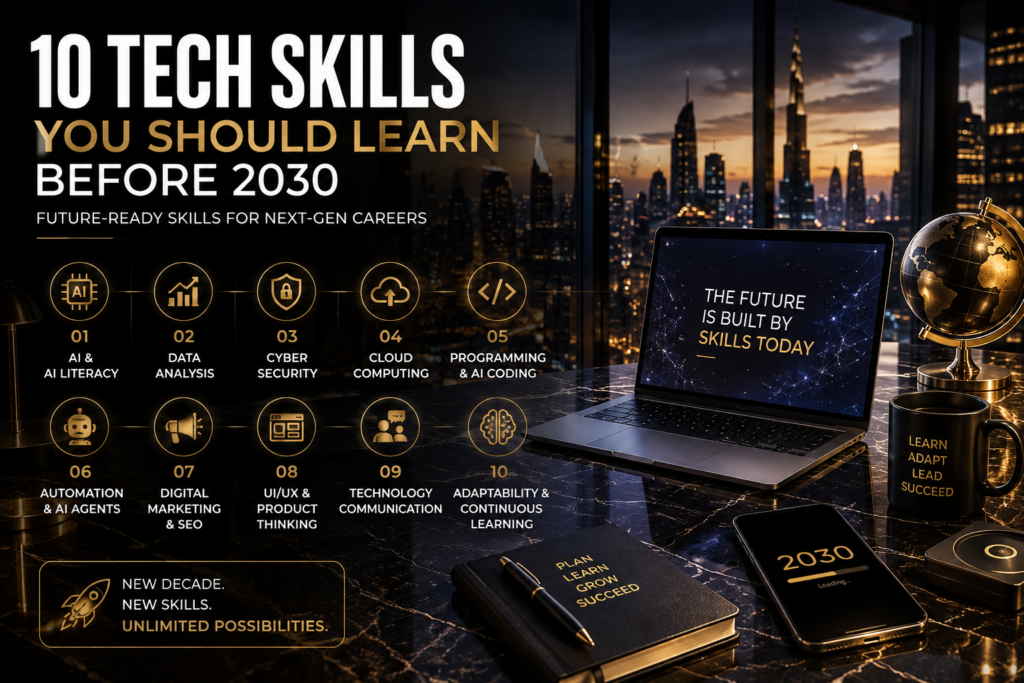
1. Artificial Intelligence and AI Literacy
AI is arguably the most important technology skill to understand before 2030.
You don’t necessarily need to become an AI engineer. But understanding how generative AI, large language models, AI agents, and automation work can give you an advantage in almost any career.
Learn how to:
- Use AI tools effectively
- Write better prompts
- Evaluate AI-generated information
- Automate repetitive tasks
- Understand basic AI concepts
- Work alongside AI rather than compete with it
AI skills are already moving beyond traditional coding. LinkedIn’s 2026 research specifically highlights AI development, prompt engineering, LLMs, and AI business strategy as growing areas.
2. Data Analysis
Businesses generate enormous amounts of data every day. The ability to turn that information into useful decisions will remain valuable.
You don’t need to become a professional data scientist to benefit from data skills.
Start with:
- Excel or Google Sheets
- SQL
- Data visualization
- Basic statistics
- Analytics platforms
- AI-assisted data analysis
The real skill isn’t simply collecting data. It’s knowing what the data is telling you and what action to take next.
3. Cybersecurity
As more businesses move online and AI becomes more powerful, cybersecurity is becoming increasingly important.
Cybersecurity isn’t only for security professionals. Developers, marketers, business owners, and everyday users all need to understand basic digital security.
Useful areas to learn include:
- Password and identity security
- Phishing detection
- Network fundamentals
- Cloud security
- Ethical hacking
- Data protection
- AI-related security risks
Cybersecurity currently ranks among the fastest-growing IT skill areas, according to LinkedIn’s 2026 IT skills research.
4. Cloud Computing
Modern websites, applications, databases, and AI systems increasingly depend on cloud infrastructure.
Understanding platforms such as AWS, Microsoft Azure, or Google Cloud can open doors to careers in development, data, cybersecurity, DevOps, and IT.
You don’t have to start by learning everything.
Begin with basic concepts such as:
Servers → Storage → Databases → Networking → APIs → Cloud services
Once you understand how these pieces work together, advanced cloud technologies become much easier to learn.
5. Programming and AI-Assisted Coding
Programming is still valuable—but the way people write software is changing.
AI coding assistants can now help developers generate code, explain errors, write tests, and speed up repetitive development work.
That doesn’t make programming irrelevant.
It makes understanding programming even more useful because you need to know whether the code generated by an AI system is actually correct.
Start with a language such as:
- Python
- JavaScript
- TypeScript
- SQL
Then learn how to use AI coding tools alongside traditional development skills.
6. Automation and AI Agents
Automation is moving beyond simple “if this, then that” workflows.
AI agents can increasingly understand goals, use tools, interact with software, and complete multiple steps.
This creates an interesting career opportunity for people who understand both business processes and technology.
Learn how to identify repetitive tasks and turn them into automated workflows.
For example:
Manual research → AI-assisted research → Automated reporting
Manual data entry → Workflow automation → Automatic database updates
The ability to find these opportunities could become just as valuable as knowing how to use the tools themselves.
7. Digital Marketing and SEO
Technology isn’t only about coding.
If you understand how people discover information online, you can build valuable skills in SEO, content marketing, analytics, social media, paid advertising, and conversion optimization.
SEO itself is changing as users increasingly interact with AI-generated answers and alternative search experiences.
Learning platforms such as Semrush, Ahrefs, Google Analytics, and other digital marketing tools can help you understand:
- Search behavior
- Keywords
- Competitors
- Website performance
- Content opportunities
- Audience behavior
The important skill is learning how to combine technology + audience understanding + business strategy.
8. UI/UX and Product Thinking
Great technology isn’t useful if people don’t know how to use it.
That’s why UI/UX and product thinking remain important.
You don’t have to become a professional designer. Understanding how users interact with websites, applications, and digital products can make you better at almost any technology-related role.
Learn the basics of:
- User research
- Wireframing
- Interface design
- Usability
- Customer journeys
- Product testing
Tools such as Figma and AI-powered design platforms also make it easier for beginners to experiment with digital product design.
9. Technology Communication
Here’s a skill that many people overlook.
Knowing technology isn’t enough. Being able to explain technology clearly is becoming increasingly valuable.
A developer may need to explain a technical issue to a business manager.
A product manager may need to communicate an AI project to customers.
A cybersecurity professional may need to explain a security risk to employees.
As technology becomes more complicated, people who can translate complex ideas into simple language can stand out.
LinkedIn’s 2026 skills research also points to communication, collaboration, leadership, and stakeholder skills as increasingly important alongside technical abilities.
10. Adaptability and Continuous Learning
This might be the most important skill on the list.
Technology will change faster than any list of skills can predict.
A tool you learn today may be replaced by something better tomorrow. A programming framework can become outdated. A new AI platform can completely change an existing workflow.
That’s why you should learn how to learn.
Build the habit of:
- Experimenting with new tools
- Taking online courses
- Building small projects
- Reading technology news
- Following industry developments
- Testing new AI tools
- Updating your skills regularly
Recent commentary on the technology workforce increasingly emphasizes adaptability and continuous learning as AI changes traditional roles and expectations.
Which Skills Should You Learn First?
You don’t need to learn all 10 simultaneously.
A practical starting point could look like this:
Beginner:
AI literacy → Data analysis → Digital marketing
Intermediate:
Automation → Programming → Cloud computing
Advanced:
AI agents → Cybersecurity → Specialized AI or data skills
Throughout the process:
Communication + adaptability
The combination is more powerful than any individual skill.
For example, someone who understands AI + data + marketing can approach problems very differently from someone who knows only one of those areas.
The Future Belongs to People Who Combine Skills
The technology jobs of 2030 may not look exactly like today’s jobs.
New roles will emerge, existing roles will change, and some repetitive tasks will increasingly be automated. The current labor market is already showing this shift, with employers placing greater emphasis on practical skills and AI capabilities.
That doesn’t mean everyone needs to become a programmer or AI researcher.
Instead, the winning combination may be technology skills + industry knowledge + human judgment.
AI can generate an answer.
You still need to know whether it’s the right answer.
Automation can complete a task.
You still need to decide whether that task should be automated.
Data can reveal a trend.
You still need to understand what the trend means.
Final Thoughts
Preparing for 2030 doesn’t mean predicting exactly which technology will dominate the future.
It means building skills that allow you to adapt when technology changes.
Start with AI literacy, data, cybersecurity, cloud computing, automation, programming, and digital tools. At the same time, develop communication, creativity, critical thinking, and adaptability.
The future of technology isn’t just about people who know the most technology.
It’s about people who know how to use technology to solve real problems.
Start learning one skill today. By 2030, that small investment could make a very big difference.